By Toner Mitchell
ALL PHOTOS BY GREG VINCI
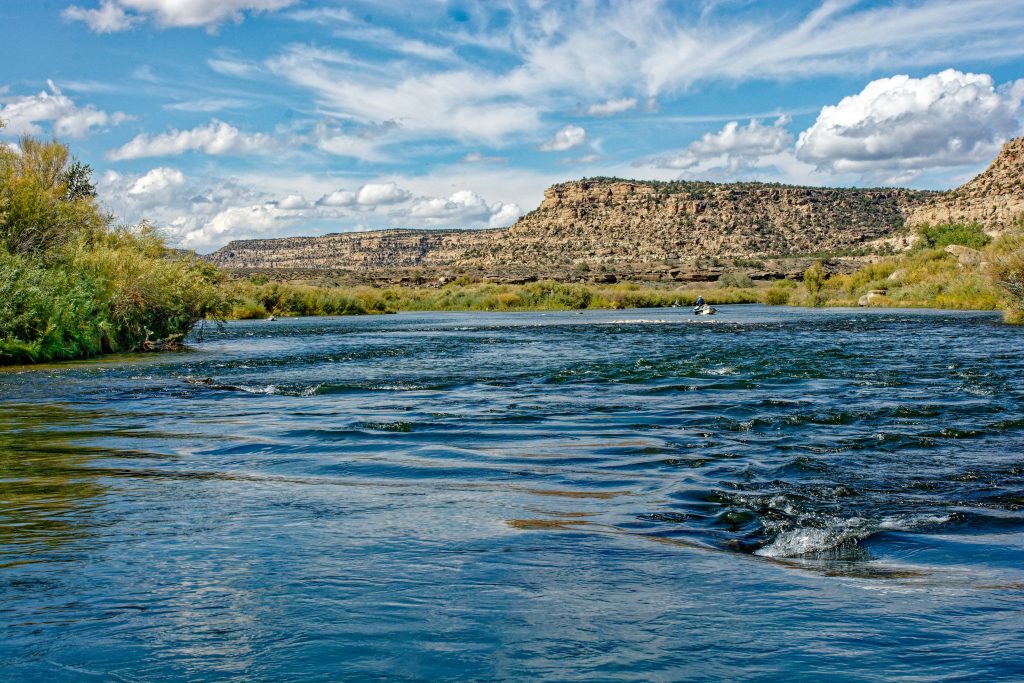
Born in the San Juan Mountains of southwestern Colorado, the San Juan River dips into New Mexico to its terminus in Lake Powell in southern Utah. The headwaters region offers great trout fishing but is perhaps better known for its vaulting peaks and skiing. The lower river in Utah is famous as a wilderness rafter’s paradise. When it comes to fly fishing on the San Juan, almost all anglers think about a mere one percent (3.5 miles) of the river’s 383-mile length: the world-renowned “Quality Waters” stretch below New Mexico’s Navajo Dam.
Every fly angler has heard of the San Juan’s prodigious fish population (several thousand per mile) of hefty rainbow and brown trout, and how these fish are more than amply fed by a seemingly infinite food supply resulting from the cold and nutrient-packed water flowing from the Navajo Reservoir. Thanks to these impressive attributes, we’ve also heard the sobering tales of the San Juan’s notorious crowds, of endless lineups of wading anglers, and flotillas of drift boats.
What isn’t well known is how easily the river accommodates all this pressure. Throughout the year, dam releases generally range from 400 to 500 cubic feet per second (cfs), with occasional flushing flows up to 5,000 (a rarity these days). The defined channel ranges from about 30 to more than 100 yards across with plenty of drop-offs and sub-channels where fish congregate. In other words, anglers can spread as far and wide as the river and still find plenty of fish.
Another factor is the large scale of the San Juan fishing economy, which is estimated at over 35 million dollars annually. Generating so much revenue from lodging, guiding, and license sales enables the fishery to fund a lot of the conservation measures required to mitigate impacts from fishing pressure. At the super-crowded Texas Hole fishing access, a restoration project was undertaken in 2012 to create a maze of braids through dense thickets of willows. The project significantly multiplied the amount of suitable trout habitat, which absorbs much of the San Juan’s angler traffic to this day.
Gearing Up
During my San Juan fishing career, I have gone through generations of gear, flies, and techniques, lots of trial and lots more error. Now that I no longer have the youth to endure long nights of whisky and cribbage followed by crack-of-dawn fishing, I’ve seen my experiences boiled down to a simple key to success: comfort.
Though not as physically demanding as other western rivers, the San Juan is brutal when it comes to weather. The Quality Waters is in a desert, where summer temperatures usually climb above 100 and drop below 90 only on the rare occasions when it rains. With so little shade in the river corridor, anglers must provide it for themselves by wearing sun gloves, sun hoodies, and wide-brim hats that fit snugly to keep from blowing off in the wind. Also, apply sunscreen frequently. Drink water even when you don’t think you need it. Your fishing success comes from understanding that overexposure to the San Juan’s sun and heat can shorten your day that might otherwise be spent reeling in memories.
The same comfort rules also apply in winter, when you should prepare for below-freezing temperatures, perpetual or gusty wind, and snow squalls. Insulate your head, neck, and hands, preferably with wind-resistant garments. Eat a full breakfast, pack a thermos of hot water, and stay hydrated. I also carry hand warmers, a spare pair of gloves, and an extra jacket and base layer in case I take a swim, which I try really hard not to do; wade safely and slowly and use a wading staff. Fix or repair leaky waders before your trip and bring a repair kit. Falling in or getting cold during winter could end your day, especially if it happens in the late afternoon. Again, being defeated by the San Juan’s brutal conditions is a distinct possibility that will cost you lifetime memories.
Gearing up for the San Juan is relatively straightforward. I prefer a stiff 4-weight rod or a soft 5-weight, rods that enable me to fish dry flies or streamers effectively in the wind. Leaders should be 9 feet long with tippets of 4X or 5X, to which you will add tippet down to 6X. Many anglers use 7X; I don’t because of the risk of breaking off flies in fish. The way I see it, if hooking or landing big fish requires extreme tackle more than skills, I’m out of my league to begin with.
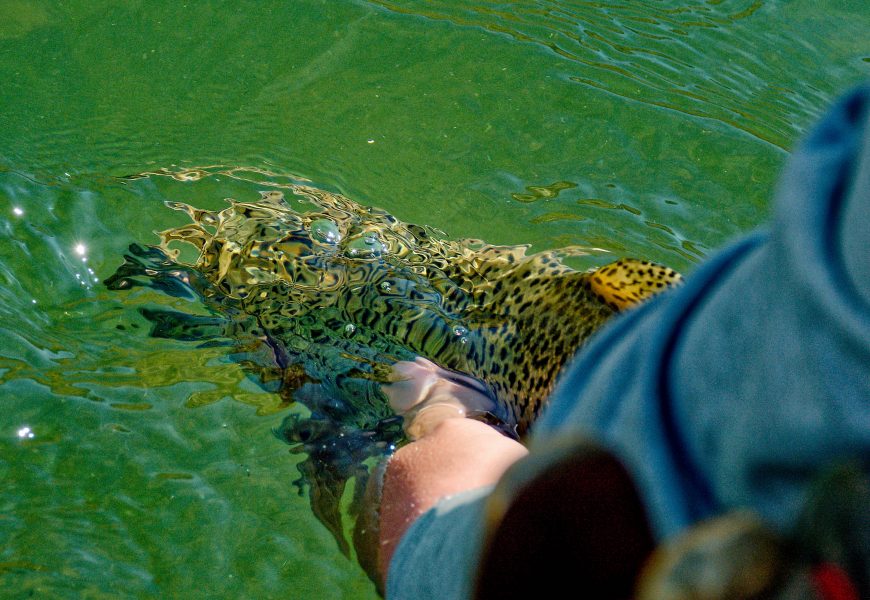
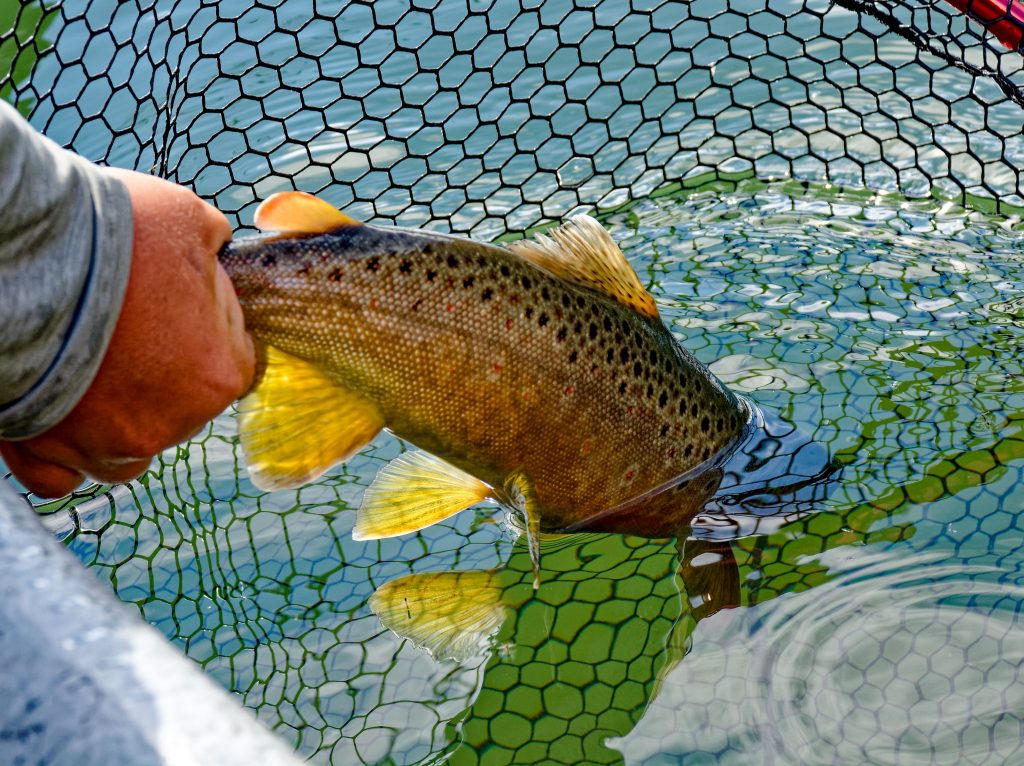
Don’t forget your fish-friendly landing net with a big bag, or delude yourself into thinking you can either land obese fish by hand while using light tippet or haul fish up on the bank. You will likely be far from the bank in the first place. Most important, beaching fish on any fishery is unacceptable, more so on the heavily-impacted San Juan.
Your choice of strike indicator matters on the San Juan. I prefer in-line indicators that sit low in the surface film and resist movement when you mend the line. My favorites are small cork balls with rubber gaskets and New Zealand wool indicators. For best results, affix your indicator 5 or 6 feet down a 9-foot leader, definitely not in the thicker butt section where mending will disturb your drift. A large, buoyant dry fly is a great indicator, too. If you go this route, remember that you can only drop one nymph below the dry because San Juan regulations prohibit the use of more than two flies. To be clear, barbless, single-hook lures and catch-and-release practices are required.
Make sure to carry line cleaner. Having seen just about everything, San Juan trout are notoriously picky when it comes to drift. A dirty fly line will sink, which induces vertical drag but, more important, causes your presentation to jerk when you mend it. You will be amazed at how flawlessly a clean line mends and how naturally your drift will continue as a result.
The Fishing
I’ve learned most of my San Juan tricks through experience, but I’ve soaked up a ton from seasoned pros like Jeff Massey, who grew up in nearby Farmington and began guiding the river in 1991. He spent most of his career with the Soaring Eagle Lodge, which he purchased with partners Mike and Christine Lyons in 2017.
As a longtime guide, Jeff naturally gravitates toward simplicity. Instead of specific named patterns, for example, he boils flies down to categories, explaining, “Leeches, Woolly Buggers, egg imitations, midge pupae, and Baetis patterns in a variety of sizes catch fish all year on the San Juan.”
He does add two particular flies to this list: Parachute Adams (for visibility and unbeatable natural appearance) and midge larva, which must be red. I would add San Juan Worms in orange, brown, pink, and red, which are especially effective during dusk and in the morning before the sun climbs too high. Include size 20 Zebra Midges and Pheasant Tail Nymphs (no legs) in your box. I prefer my leeches thin and small (size 12), made of white, black, or gray bunny strips. My white San Juan leeches also clean up in Alaska when salmon flesh becomes scarce in late fall.
According to Massey, the biggest mistake nymph anglers make is not setting the hook, understandable given the river’s gentle flows and tiny trout foods. “Trout on the San Juan can bring a light bite,” he says. “Many anglers ignore such bites, maybe thinking their indicator should drop below the surface. Many nymphing eats barely move the indicator at all. When in doubt, set the hook.”
Mark Nesbit, owner of Blue Sky Fly Fishing, believes anglers miss a lot of fish by forgetting to check their flies to make sure they’re free of moss and weeds. A stickler for the drag free drift, Nesbit advises to mend early and often. In my experience, big mends deliver better than small ones. Follow-up mending should happen before your previous mend straightens out. Try to run your flies and indicator through currents of the same speed. When placing your cast, your indicator should land directly down current from your flies. As always, this is easier said than done. In the best of circumstances, especially on the San Juan, micro currents will act on your leader and tippet. They may also act positively on your flies, perhaps adding to their natural appearance.
Because the San Juan’s picky fish are even pickier during hatches, Massey loves to work surface feeders with his clients. To be most successful, he advises his anglers to keep their flies dry and make sure their casts turn over completely before dropping to the water, tactics that make tracking tiny flies easier. He stresses the importance of putting flies in front of target fish.
“I’ve found that fishing the water during a hatch doesn’t work as well. A common mistake is just landing a fly above a whole pod of fish and letting it drift all the way through. A recipe for drag and no fish. Be disciplined. Pick a target. Leading that fish by only two seconds will result in a cleaner drift and more hookups,” he advises. Like Massey’s, Nesbit’s clients get better results by turning over their casts, also by fishing downstream to rising fish instead of upstream. “You want the fish to see your fly before your tippet,” he says, “and before the leader starts to drag.”
Nesbit recommends a downstream curve cast timed to when the target fish is looking up, as opposed to just after its previous rise. He says a common mistake is setting the hook too quickly and not letting the fish take the fly down.
Surface activity on the San Juan is often localized to specific reaches, even to certain runs. Especially during winter, it can also be frustratingly brief. So be prepared to change flies quickly, usually in the direction of subtlety. In other words, from high floating to barely subsurface, dun to cripple, bigger to smaller. Practice tying knots fast; Nesbit and I use the turle knot, which is easy, fast, and solid.
The hatches you will most likely encounter include midges, Baetis, and Pale Morning Duns. When a cloud covers the sun on warm spring or autumn days, don’t be surprised to see Baetis duns popping off along with a spate of rising fish. When patrolling calm flats, keep an eye peeled for nose-dimple rises to midges. Although this could happen at any time of year, a midge hatch in winter is a special treat. Crank up your discipline and remember to target individual fish.
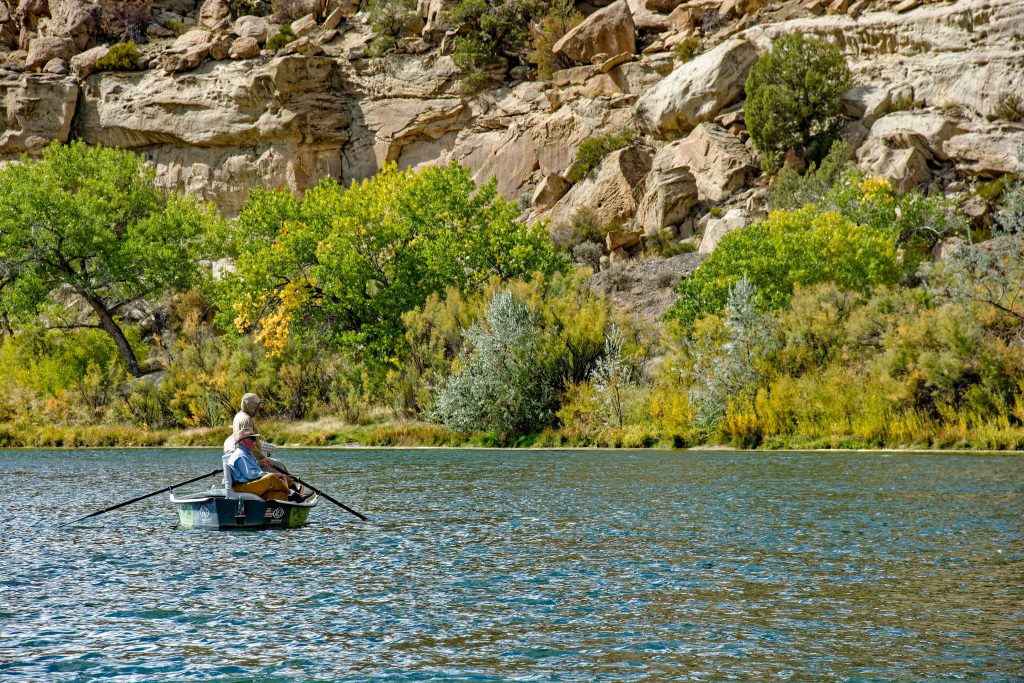
Despite generally hatch-based fishing, dry-fly diehards should take heart, as happenstance opportunities do present themselves. If you spot a fish hugging the bank on a hot summer day, consider throwing a hopper at it. Maybe you’ll hear the buzz of cicadas coming from the surrounding mesas and have a big black ugly in your box to tie on. Perhaps your trip will coincide with a flying ant fall, an event that happens once a year, lasts for several days, and causes the San Juan’s discerning fish to forget their caution. The ant hatch is triggered by the onset of the summer monsoon thunderstorm season, which usually occurs from late June to mid-July. As such, it’s difficult to plan a trip around the ants, unless you can drop everything and buy a plane ticket on a dime.
A discussion on fishing the San Juan is incomplete if it doesn’t address a relatively recent phenomenon. For a river known for its ability to grow a lot of large trout in not a lot of time, tales of huge trophies have not been as common as one would expect. Sure, we figured that there were anglers out there throwing 6-inch streamers for fishless hours at a time but landing the occasional super-size trout. Perhaps due to the advent of 24/7 social media, we’re starting to hear more about these lunkers, and that a good many of them are being taken on everyday gear. These are brown trout, sublimely silver with olive backs and subtle blue cheeks, that weigh from 8 and 15 (some look like 20) pounds. Nesbit believes the best way to run into one is to cast a jig-head leech three quarters upstream and try to strip it back along the bottom. Massey doesn’t claim to know the answer to getting one of these browns. His advice is to simply put in the hours to increase your odds.
The Spots
The San Juan is accessible from five main parking areas along Highway 511. From upstream to the downstream terminus of the Quality Waters, they are: Cable Hole, Texas Hole, Munoz, Simon Point, and Crusher Hole.
The Cable Hole parking area is a stone’s throw from the Navajo Dam, about a 10-minute walk downhill to the river. Since 9/11, a previously wonderful stretch of slow fishing water immediately below the dam was closed to public access, leaving a football field-size, gentle riffle below. What I like most about this area is the ability to fish while I’m daydreaming. You can literally just walk in circles and cast—the wading is very safe—knowing that fish are everywhere. What I like least about it is how early the sun drops behind the nearby western mesa in winter, at which point the temperature takes a dive. The river narrows and accelerates at the bottom end and then quickly opens up again into glassy flats punctuated by several islands. There is plenty of wadable water there, along with drop-offs, which aren’t difficult to navigate when the water is clear. However, when the lake turns over in spring and late fall and the releases get a little murky, be careful because it’s easy to make a wading mistake.
Down the road is the Texas Hole parking lot, and you’d be forgiven for thinking that you’re at a ski area and not a trout stream. Texas Hole draws the San Juan’s biggest crowds, but again, its extensive network of islands, braids, and pools absorbs a lot of anglers with plenty of elbow room and fish for all. In any case, anglers feeling pinched can find solitude by walking upstream to the Upper Flats (about five minutes) or by exploring downstream.
From Munoz, you can walk five minutes to the river and fish upstream through a loaded stretch of flat water known as Baetis Bend. Or hike 20 minutes upstream to the Lower Flats. I prefer going up, leaving my pack on an island, and wandering around until lunch. Since the San Juan is devoid of surface features, reading the water is a matter of recognizing drop offs and depth changes. Nowhere is this truer than at the Lower Flats, where reading the water successfully is a significant part of the fun. You can easily spend a full day at any of the San Juan’s access points. I usually spend two days at Munoz, doing the Lower Flats one day, Baetis Bend the next, exploring the north bank (infrequently done on the San Juan), or just wandering between the two main areas. As you can probably tell, you can make a day on the San Juan as intense or as relaxed as you want. After years of fishing the Lower Flats, I have mapped out some great, out-of-the-wind napping spots.
The lowest access on the river is at Crusher Hole, where most of the day’s boat traffic disembarks. For this reason—at the end of a long and successful day, most guides and their clients are happy to fish through instead of dropping anchor or back-rowing— the run above Crusher is rarely crowded and provides some great fishing to the last hours of daylight. The fish aren’t as big above Crusher, mainly because bait anglers sneak up from below the catch-and-release line to harvest lunkers. But that’s on average; you will still catch plenty of fish, and the chances of catching big fish are still high.
If I had to choose my favorite fishing spot on the San Juan, I think it would be Simon Point, the access point between Munoz and Crusher. More exactly, it would be the Simon Canyon parking area across the river from Simon Point, which is not in the Navajo Lake State Park but on Bureau of Land Management land. To get there, you have to cross the river in the community of Navajo Dam and drive a few miles upstream on a dirt road. Simon Point and Simon Canyon are directly across the river from each other, but Simon Canyon provides easier, out-of-the-car access, shade for a picnic, and the option of hiking up a dry wash to view ancient puebloan dwellings inhabited approximately 800 years ago. Relative to any other spot in the Quality Waters section, there is nothing particularly outstanding about Simon Canyon.
Apart from the cottonwood trees, that is. In the fall, they blaze yellow at a time when the river, and definitely the sky, is blue. During summer, their shade is like the inside of a thick-walled adobe house, welcoming and cool. No matter the time of year, I can always find perfect fishing at Simon.
Toner Mitchel is the New Mexico Rural Engagement Manager for Trout Unlimited and a longtime contributor to American Fly Fishing magazine.
NOTEBOOK
When: Year-round.
Where: Navajo Lake State Park, San Juan Quality Waters, northern New Mexico.
Headquarters: Farmington and Bloomfield, and the community of Navajo Dam. Information: Aztec Chamber of Commerce, (505) 517-3156, www.aztecchamber.com; Farmington Chamber of Commerce, (505) 325-0279, www.gofarmington.com.
Lodging: Located along the riverbank, Soaring Eagle Lodge, (505) 632-3721, www.soaringeaglelodge.net, offers lodging, meals, guide service, and a full fly shop.
Appropriate gear: 9- to 11-ft. 4- or 5-weight rod, floating line, 4X‒6X leaders and tippet.
Useful fly patterns: Egg patterns (chartreuse, yellow, orange, pink), midge larvae patterns (red, orange, olive), San Juan Worm (red, orange, pink, brown), Griffith’s Gnat; flying ants; hopper patterns, RS2 (olive, gray), Johnny Flash (gray, brown, black), WD40 (gray, brown, black), Zebra Midge (black, red), Comparadun (gray, olive), Parachute Adams, Bunny Leech (white, olive, black), white Sculpzilla.
Necessary accessories: Polarized sunglasses, wide-brimmed hat, sun gloves, landing net, neck gaiter, chest waders, adequate layering and insulation in winter, hand warmers, long sleeve shirt in tan or blue-sky color, wading staff, stream seine (no stomach pump, please), clothing to match often extreme weather and sun conditions..
Nonresident license: $12/1 day, $24/5 days, $56/annual, plus $4 Habitat Management and Access Validation (HMAV) and $10 Habitat Stamp.
Fly shops/guides: Soaring Eagle Lodge, (505) 632-3721, www.soaringeaglelodge.net; Blue Sky Fly Fishing, (505) 634-0582, www.sanjuanflyfishing.net.
Maps: New Mexico Atlas & Gazetteer by DeLorme; TroutRoutes app.