Story and photos by Luke Probasco
We checked into our motel in Forks late Wednesday night, just hours before it was time to hit the water. Ignoring whatever was happening in the rooms on both sides of us, we lay awake staring at the ceiling. Not because of the noise, but because, with the legendary Hoh River just 20 minutes away, it felt like Christmas Eve. Sleep wasn’t really an option.
I discovered this storied river later in life than I should have. My father, Steve, had been there long before me. He wrote a book about it, part of the Steelhead River Journal series, and his descriptions stayed with me for years the way a good piece of writing will. When he passed in 2025, I decided to spend more time on the Hoh and build my own connection with the river. My fishing partner, Mauricio, was quick to join.
I have known Mauricio for 25 years. He has become, over the decades, one of my most trusted friends and my most reliable reader on a steelhead river—the kind of partner who spots the seam you missed, talks you down when the run you were counting on is somebody else’s leapfrog stop, and never once suggests it might be time to quit. Mauricio is always “DTF”— Down to Fish—in all conditions and at all hours. He never takes a bad day personally and is well versed in the Olympic Peninsula (aka OP) steelheading program: a cooler of Rainier beer and plenty of snacks. River rule number 33: always bring ranch-flavor Corn Nuts.
That feeling—the specific, slightly irrational excitement of being close to a great steelhead river the night before you fish it—is one of the things steelheading produces that other forms of fishing mostly don’t. There is a part of Washington’s Olympic Peninsula that steelheaders talk about the way other people talk about places they’ve never been but fully intend to go before they die. The mention of the OP among people who swing flies produces a particular expression: something between reverence and longing and the low-grade guilt of someone who knows they haven’t made the trip yet. Steelheading here is as close to fishing in British Columbia or Alaska as you can get without leaving the continental United States. The rivers are big, cold, and wild. The fish are large, chrome, and fresh from the Pacific. The rain forest through which they move is one of the most extraordinary landscapes on the continent. And the public access—long gravel bars, multiple launches, roads that actually reach the water—is better than almost anywhere else you’d want to swing flies for winter-run steelhead. The Olympic Peninsula is a steelheader’s Montana. Everyone shows up sooner or later.
The River
The Olympic Peninsula receives 14 feet of rain per year. Yes, feet. Not inches. Most of it falls between October and April. Storms pile in off the Pacific and crash into the Olympic Mountains, dropping immense quantities of moisture that feed some of the most productive river systems in the Lower 48. The ground drains with extraordinary efficiency—after a 4-inch rain event, the roadside puddles are gone within 12 hours. These rivers are a direct expression of the mountains above them: powerful and alive in a way that rivers in drier country simply are not.
The Hoh is born on the flanks of Mount Olympus at 7,965 feet, where the Tom and Humes Glaciers release cold melt water. Three main branches converge—the North Fork, the South Fork, and Tom Creek, often called the Middle Fork. Their combined flow runs some 50 miles southwest through one of the last true temperate rain forests in North America before meeting the Pacific Ocean near Oil City, which is not a city. An oil exploration venture there in the 1930s came up dry. The name stuck.
The glacial influence defines everything about fishing the Hoh. The river runs turquoise-gray from glacial flour—finely ground mineral silt that holds visibility to 2 or 3 feet. This same silt scours the river bottom clean of algae, so the rocks underfoot are bare and firm rather than slick. The trade-off is a river that confuses first-timers. Three sunny days in the mountains can raise the river when you’d expect it to drop, and it can blow out and fall back to fishable inside 48 hours. For winter steelheading, ideal flows sit between 1,200 and 3,500 cubic feet per second (cfs). Below 800 cfs, fish go quiet.
The valley has history that predates sport fishing. The Hoh Tribe has inhabited this coastline for thousands of years, and Native American populations on the OP extend back thousands of years before that, as demonstrated by a remarkable 1977 discovery much studied by archaeologists: the remains of a mastodon with a 13,800-year-old projectile point—itself made of mastodon bone—embedded in its ribcage. White settlers arrived in the Hoh Valley in the 1890s; most were driven out by the river, which reclaims its floodplain with unsentimental regularity. The Huelsdonks, Andersons, and Fletchers stayed. John Huelsdonk—the Iron Man of the Hoh—earned his nickname through feats of endurance that became local legend. The story most often told is that he packed a cast-iron cookstove on his back to his homestead on the upper river. When asked if it wasn’t a bit heavy, he replied that the stove was fine—it was the 100-pound sack of flour shifting around inside the oven that gave him trouble. His descendants still live in the valley. The house he built after the original burned in 1935 can be seen from a drift boat on the upper river.
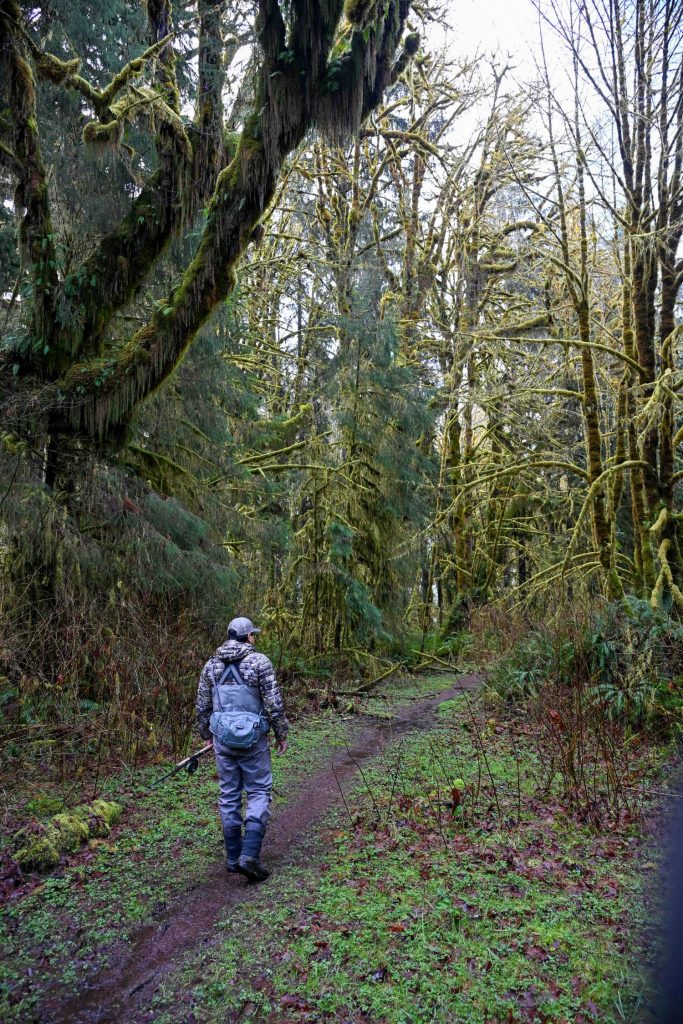
It’s well worth slowing down to enjoy and experience the landscape. Sitka spruce, western red cedar, and western hemlock grow to dimensions that feel prehistoric—centuries old, 200 feet tall, draped in club moss and licorice fern. Roosevelt elk move through the timber at the edges of visibility in the mornings. This is one of the most complete temperate rain forests remaining in the world, and roughly half the Hoh’s length flows through Olympic National Park. That permanence is the primary reason the Hoh still has enough wild steelhead to support a worthwhile fishery today.
Upper and Lower Hoh
The river divides in character as much as geography at the U.S. Highway 101 bridge. The upper Hoh is classic steelhead water: long, gently-tapering runs over rock-and-gravel bottoms, manageable currents, and enough structure to hold fish through a range of flows. The road parallels much of it. The gravel bars are wide, and in many stretches, you can read the holding water from the bank before you ever get wet.
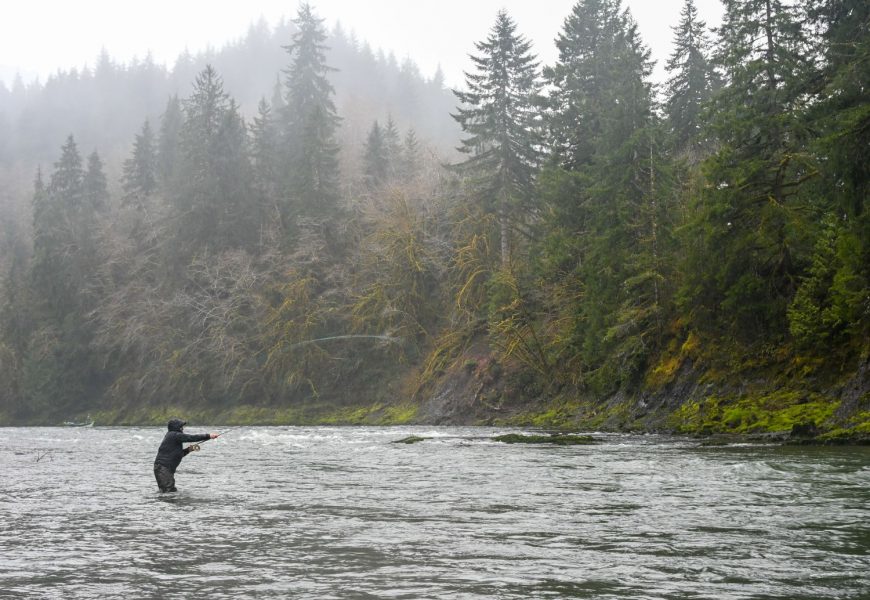
The Hoh is big water, and your gear should reflect that. A 7- or 8-weight two-handed rod is the right tool; you need the reach to cover the runs and, when a fish decides it’s going back to the ocean, you need a rod with the backbone to stop it from doing exactly that. That holds especially true on the upper river, where the runs stretch long and require covering water methodically—step, cast, swing, step, repeat.
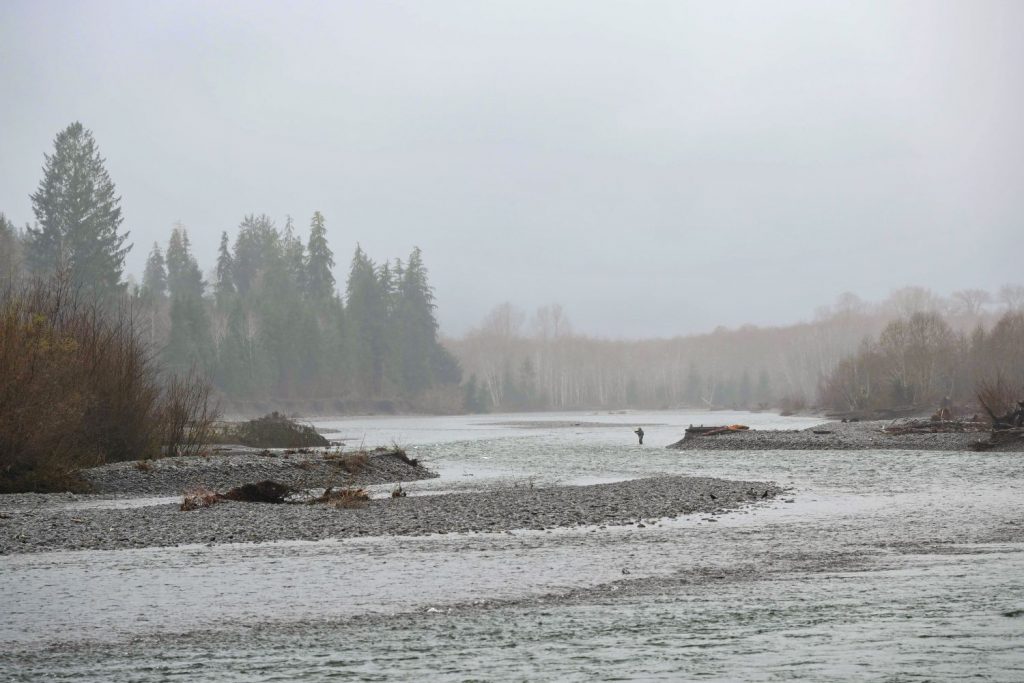
The lower Hoh is a different animal. Wider and more powerful, it runs with the full weight of the watershed as it makes its final push toward the Pacific. Oil City Road traces the lower river and provides solid bank access at turnouts, trailheads, and Cottonwood Campground. What the lower river offers that the upper does not is proximity to the ocean and the freshest fish in the system—chrome as a new dime, sea-liced, with the full energy of the North Pacific still in their muscles.
Flow levels should guide where you fish. When the river is running high, move upstream. The upper Hoh offers more manageable water, and fish pushed into shallower runs to rest. When flows drop, work your way down. Low water on the lower Hoh concentrates fish and keeps the freshest arrivals closest to the ocean. Shrimp colors—pink, cerise, orange—tend to produce well in the lower reaches, where fish are still responding to saltwater instincts.
Working from the top of the fishable water down, launches on the upper river include the Park Entrance ramp half a mile inside Olympic National Park, Morgan’s Crossing, Minnie Peterson, and Hoh Oxbow Campground. On the lower river: Cottonwood, Allan’s Bar, G&L, and Barlow’s. Not all of these are developed ramps—Minnie Peterson and the park entrance are primitive affairs where you back a trailer down a muddy track off the side of the road into the water. Come prepared. Barlow’s has moved considerably in recent seasons as the river changed course, so before any float, check current conditions with local outfitters.
Drift boats and rafts are the standard vessels. But a single-person inflatable like a Watermaster is well-suited to the Hoh for the angler who wants to go solo or access water that larger craft pass. A Watermaster can be kicked into position in a run, held against the current with minimal effort, and beached on gravel bars a drift boat would avoid. That said, the Hoh commands respect from any vessel. Logjams shift, channels change, and the canyon below Morgan’s Crossing can push into technical territory at higher flows. Know your oar skills and scout anything uncertain. For those without watercraft, the Upper Hoh Road provides bank access at several points where the river swings close to the pavement. When flows are higher than ideal for floating, the upper river above Minnie Peterson offers legitimate walk-and-wade water with significantly fewer boats competing for the same runs.
The Fish
All of which is to say: the fish are the reason, but the Hoh is something larger than any single season’s catch. Steelhead enter the river every month of the year. The summer run peaks in September and October in lower, clearer water and offers the possibility—genuinely available here—of a fish taking a waking dry fly. Summer fish are considerably less abundant than winter runs, so the fishing is quieter and more technical by necessity as much as by nature, rewarding precise presentation in ways the winter fishery does not always require. They are worth knowing about but come with realistic expectations.
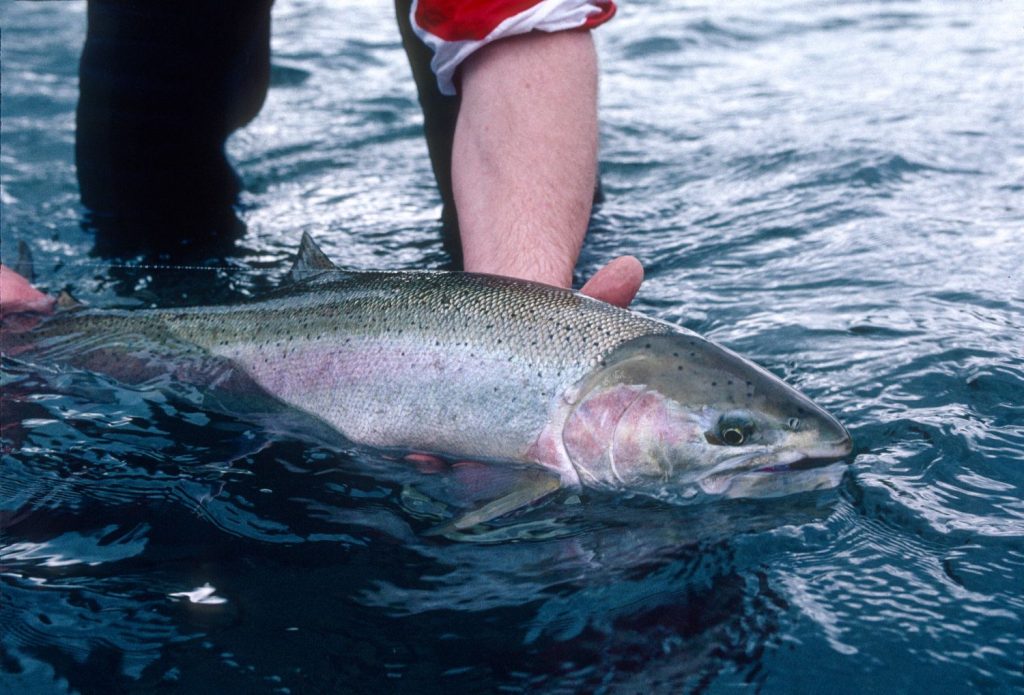
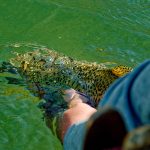
The winter run built the Hoh’s reputation and keeps the trucks lined up at the launches in January and February. Fish start showing in November and run through April, with the largest natives arriving late in the season. The Hoh consistently produces steelhead in the 20-pound class, and in a good year fish over 25 pounds are caught often enough that word travels fast. They fight with the energy of fish that haven’t yet spent weeks burning down their reserves in fresh water. When a wild Hoh steelhead finally comes to hand and you kneel in the current to hold it—the radiant coral flush on the gill plates, the silver flanks against the glacial-green river bottom—there is not much else to say. You understand completely why people drive through the night to get here.
Studded wading boots and a wading staff are not optional. The current is stronger than it looks from the bank, and with 2 to 3 feet of visibility underfoot, wading past your knees becomes a considered act.
Standard winter gear is that 7- or 8-weight Spey rod, 12.5 to 14 feet long, with a Skagit head in the 550- to 650-grain range and T-11 or T-14 sinking tips. The standard prescription is a large Intruder-style pattern in black/blue or pink/orange. But one veteran guide who has fished the Hoh for three decades has a different view of what pressured fish want. By mid-season, he reasons, every fish in the river has seen a parade of large, dark, flashy patterns swung past its nose. His answer is to go small and sparse—something so different that the fish simply hasn’t learned to ignore it yet. He runs a longer leader to keep the fly away from the hardware of the tip and catches fish when others on the same water don’t. The lesson: think about what the fish has already seen. On a river with this much pressure, different is almost always worth trying.
All that said, there’s a significant place here for reverence and nostalgia. After all, the mighty Hoh, alongside other OP rivers, was a laboratory for one of the sport’s most influential steelhead fly designers and winter steelhead fly-fishing pioneers: Syd Glasso, who roamed these waters 75 years ago. So, if you love Glasso patterns, such as the famous Orange Heron and its countless descendants, swing them with confidence. But emulate Glasso: owing to that glacially stained water, he tied his flies larger for the Hoh than he did for the Sol Duc, Bogachiel, and other rivers.
The Camaraderie
Forks, Washington is best known to the outside world as the setting for the Twilight series—the vampire romance franchise that filled its gift shops with Team Edward merchandise. What the tours don’t advertise is that Forks is, at its core, a fishing town. Every winter it fills quietly with steelheaders the way the rivers fill with fish. Walk into any restaurant during steelhead season wearing a Patagonia puffy and skin the color of a day spent on the river and the waitress will ask how the fishing was before you’ve found your seat. Not whether you were fishing. How it was. This is a town that knows its people.
The steelhead bum lifestyle has its own texture. It is eating yesterday’s Mexican food for breakfast with your fingers because your hotel room doesn’t have utensils. It is checking the gauge at midnight and again at four in the morning. It is the specific satisfaction of an $85 motel room with everything you need: a bed, a hot shower, and a parking spot big enough for a trailer. Steelheading creates a community of people who understand each other without much introduction. The Hoh concentrates them.

There is a culture on the Hoh, as there is on any river that draws the same people back year after year. You see it in the nod exchanged between trucks towing drift boats on 101 in the early morning. You see it at the launches, where guides who have floated the same water for decades compare notes with strangers who drove from Idaho for the week. You see it in the way people share stories at the end of a float—not just about fish caught or lost, but about the run that looked perfect and produced nothing, the fog that lifted at exactly the right moment, the elk that stepped out of the spruce copse on the far bank long enough for everyone in the boat to stop casting.
Fishing a big river with a trusted partner is a particular pleasure. Mauricio and I have been fishing together long enough that we have our own shorthand—a glance at a seam, a nod at the far bank, the wordless agreement that one of us works the head of the run while the other covers the tail. He calls a run correctly, spots the holding water you walked past because you were watching your footing, and is genuinely happy when you hook a fish even when it was his turn in the rotation. We trade runs without counting or keeping score, because the point is to be there together and the fish are a bonus.
On the water, Mauricio is my eyes as much as my partner. The Hoh’s limited visibility makes oaring through boulder gardens a navigational act of faith, and having someone in the bow reading the current ahead—calling out the tongue of water between two submerged rocks, flagging the pour-over that would put you sideways—is not a small thing. Above the Oxbow, the river over a short falls that gets your attention the first time you hear it before you see it. It can be run, but you want to know it is coming. That kind of partnership is earned over time, and worth more than any piece of gear you can buy.
I met a man named Walter from Colorado on the river last season who had read my father’s book and found his way to the Hoh because of it—the same way I eventually did. We stood on a gravel bar in the fog and talked the way people do when they realize they arrived at the same place by different roads. He emailed me afterward: “Your dad’s book is really what got us out on the Hoh. I think your dad might have had a little something to do with us all meeting out there, because the odds are absolutely nuts.” Standing there in the fog with a stranger connected to me by a book and a river, I understood something about what this place does to people. The Hoh has a way of assembling folks on its gravel bars and introducing them to each other. It is, among its other considerable qualities, that kind of place.
What the River Asks
Here is the part that belongs in this story whether it is comfortable or not.
The Hoh is carrying more weight than it used to. Launches are crowded well before first light in peak season. One guide told me he went down six times this past season, twice the season before, twice the season before that. He used to spend 65 days a winter on the river. He stopped going primarily because of the crowds. “I’m not getting in line for native steelhead,” he said. “That’s not the deal.”
Part of this is the river’s own fame. Part of it is that other rivers have closed—the Skagit, the Sauk, the Satsop, the Wynoochee, dozens of smaller coastal streams. Olympic National Park has closed the Queets every year since December 2020 after consecutive years of missed escapement targets. Every closure concentrates the same pressure into fewer places.
Research published in the North American Journal of Fisheries Management by John McMillan, Matt Sloat, and colleagues paints a sobering picture. Comparing historical run sizes from roughly 1948–1960 to contemporary data, the average annual wild winter steelhead run in the Hoh was estimated at 13,505 fish. Run sizes have declined even more sharply in the past decade. Comparing those historical estimates to the most recent five-year period analyzed (2013–2017), returns of wild steelhead in the Hoh have declined by 80 percent. Run timing has shifted as well—peak returns now occur one to two months later than they did historically, and the overall window of migration has contracted by as many as 26 days. Historically, 43 percent of wild Hoh steelhead entered the river before January 1. That early run—the big, bright fish that built the river’s reputation—is largely gone. Causes are multiple and extend well beyond the river itself.
Washington Department of Fish and Wildlife (WDFW) research published in 2025 found that warming sea surface temperatures and elevated pink salmon abundance in the North Pacific may both reduce steelhead survival at sea. Pink salmon and steelhead share the same North Pacific feeding grounds, and in high-abundance pink years—which follow a strict two-year cycle—competition for prey depresses steelhead survival across their multi-year ocean residency. Warmer water compounds the problem by reducing the cold-water food sources steelhead require to build the size and strength they need to make it back to the Hoh. These fish are running a gauntlet that begins long before they reach the river.
The picture is not hopeless. Habitat is measurably better than it was 30 years ago (see National Oceanic and Atmospheric Administration, “Biological Status of the Olympic Peninsula Steelhead Distinct Population Segment: Report of the Status Review Team,” 2024). Salmon and steelhead have returned to streams they hadn’t entered since the 1910s. The Elwha, 30 miles north, had its dams removed and is rebuilding wild populations from the ground up.
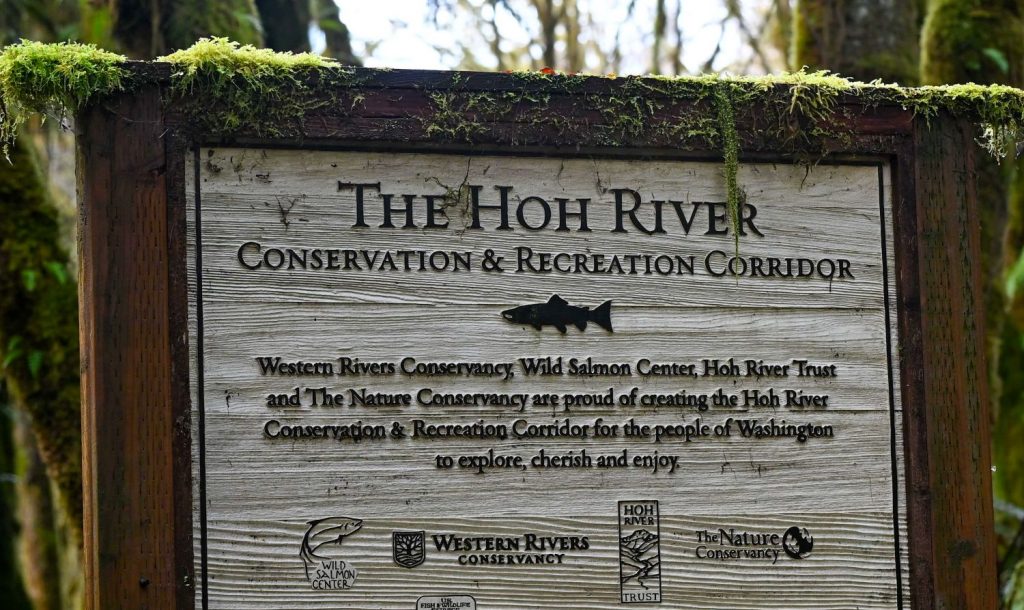
Western Rivers Conservancy has protected over 10,000 acres along the lower Hoh—56 miles of connected habitat from the Olympic Mountains to the Pacific, now stewarded by The Nature Conservancy. Trout Unlimited, along with Coast Salmon Partnership and Wild Salmon Center, are working alongside coastal tribes, and federal and state agencies as part of the Coldwater Connection Campaign. This collective effort works to remove migration barriers, reconnect floodplains, and restore critical spawning and rearing habitat for struggling populations of wild salmon and steelhead.
The fish, given the right conditions, will fight back.
Jonathan Stumpf, who heads up Trout Unlimited’s Wild Steelhead Initiative, has been engaged in steelhead management reform on the Olympic Peninsula for more than a decade, working within a variety of the state fish and game advisory groups and tackling topics that include establishing forward-thinking adaptive management regimes, hatchery reform, and even fishing regulation changes. He often points to Puget Sound’s Skagit River steelhead management plan as a starting point for balancing tribal and sport fisheries while actively working to recover steelhead populations and believes this management approach should be implemented on the OP. “If we take care of the fish,” Stumpf says, “the fishing will take care of itself.”
What the river asks is not complicated: treat the fish with more care than the photograph requires; support the organizations doing the habitat work, science work, and fisheries management reform.
On the River
On my last morning on the Hoh, we got to the water before the other trucks. The fog was down in the valley, the river was the color of pale jade, and the only sound was the current working around a boulder that had been there since before the highway existed. I stood at the head of a long run, made the first cast, and watched the fly swing through the seam and come to the dangle. Nothing. One step downstream. Cast again. Repeat.
This is the central fact of steelheading: most of the time, nothing happens. The fish are there or they are not, taking or they are not, and there is no reliable way to determine which is true except by making the cast. My father wrote about standing in a Hoh River run and feeling contentment overcome his being, about the tug when it was time to leave, the force trying to keep him there. I felt both of those things. I understand now what kind of place it takes to produce that effect.
I never hooked a wild Hoh steelhead last season. But I stood in the river and watched the fog lift off the gravel bars and listened to the old growth creak in the wind above the bank, and I understood completely why people drive through the night to get here and why they come back year after year until it becomes the organizing principle of their winters. The river earns the reputation. It earns the drive and the bad sleep and the Christmas Eve feeling in a Forks motel room.
The Hoh is still one of the great steelhead rivers. Come prepared for big water, limited visibility, and more boats at the launches than you’d like. Bring a Spey rod and a box of flies that includes something smaller and sparser than everyone else is throwing. Eat at Blakeslee’s Bar and Grill and nod at the other trucks on 101. Hire a guide if it’s your first time. Handle every wild fish like it matters—because it does.
And when it’s time to load the boat and the gravel bar is still calling you back—when you find yourself making one more cast you didn’t plan on making, watching the fly swing through water you’ve already fished twice—that’s the river doing what it has always done. My father felt it. I felt it. You will too.
Luke Probasco is a Washington-state-based freelance writer and photographer. Visit him at www.lukeprobasco.com.
NOTEBOOK
Where: Olympic Peninsula, Washington
When: Winter steelhead run November‒March, peaking February/March. Regulations change frequently and emergency closures happen mid-season—always verify current rules with WDFW (wdfw.wa.gov) before arriving.
Access: Best as a float fishery, but walk-and-wade access is good in places. Access to the Hoh River is generally divided into the upper Hoh (above the Hwy. 101 bridge) and the lower Hoh (below the bridge to the Pacific Ocean). The river is highly regarded for its accessibility, as much of it flows through public lands and the Upper Hoh Road parallels the upper section for about 15 miles
Headquarters: Forks, WA.Several motels offer angler’s rates. Information: Forks Chamber of Commerce, (800) 443-6757, www.forkswa.com. Camping: Hoh Oxbow Campground, Bogachiel State Park, Minnie Peterson, and Cottonwood (book ahead for peak season).
Appropriate gear: 12.5- to 14-ft., 7- and 8-wt. Spey rods; 550- to 650-grain Skagit heads, T-11 or T-14 sinking tips.
Useful fly patterns: Probasco Poacher, Fever Dream, Hoh Bo Spey, Fish Taco, Twist and Shout, Intruders (especially black/blue or pink/orange), Orange Heron; small, sparse patterns when the river has been crowded with anglers.
Necessary accessories: Chest waders, studded wading boots, wading staff, polarized sunglasses, spare set of under-wader clothing, warm clothing.
Nonresident license: $27.05/1 day, $39.19/2 days, $48.30/3 days, $115.85/annual. A steelhead/salmon punch card is required in addition to a standard fishing license (no charge).
Fly shops/guides: Port Angeles: Waters West Fly Fishing Outfitters, (360) 417-0937, www.waterswest.com. Raincoast Guides, (360) 301-4559, www.raincoastguides.com; Confluence Guide Service, (302) 725-7694, www.confluenceguideservice.com; Caleb Hitzfeld, (360) 640-8513, www.chflyfishing.com; Olympic Peninsula Fly Fishing (Gray Struznik), Opflyfishing@gmail.com; Trevor Covich, opflyguy@gmail.com; Anadromy Fly Fishing, (360) 460-3500, www.anadromyflyfishing.com; Real Deal Guides, (724) 591-2714, www.realdealguides.com; Chrome Chasers Fly Fishing (Keith Allison), (253) 255-5963, www.chromechasersflyfishing.com.
Books/maps: Steelhead River Journal: Hoh River by Steve Probasco;The Color of Winter: Steelhead Fly Fishing on the Olympic Peninsula by Doug Rose; Modern Steelhead Flies by Rob Russell and Jay Nicholas.
Conservation: Handling fish: All wild steelhead must be released. Keep fish fully submerged. Use a rubber-mesh net. Minimize air exposure. Land fish quickly. Every wild fish that reaches spawning gravel matters. Get involved: Western Rivers Conservancy, www.westernrivers.org; Trout Unlimited, www.tu.org, www.wildsteelheaders.org; The Conservation Angler, www.theconservationangler.org; Coast Salmon Partnership, www.coastsalmonpartnership.org; Wild Salmon Center, www.wildsalmoncenter.org.