The Trophy Water: Mio to McKinley
By Bob Linsenman · Originally published March 22, 2011 · Updated September 2026
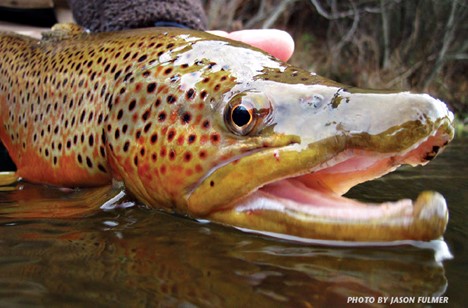
Michigan’s Au Sable River is widely regarded as one of the finest brown trout fisheries east of the Rocky Mountains, and its Trophy Water is where the river grows its largest fish. This is the 15 or so river miles from the town of Mio downstream to McKinley Landing, managed under special regulations and fed by cold springs. Gravel, undercut banks, and a food supply thick with mayflies, caddisflies, crayfish, and sculpins push brown trout past 20 inches in numbers few Midwestern rivers can match. The genuine giants, over 24 inches, fall most often to large streamers.
What follows is a guide to both stretches of the Trophy Water: where to park and wade, which hatches are worth timing a trip around, and the techniques that consistently move big fish here.
Au Sable Trophy Water: Fast Facts
| Where | Northeastern Lower Peninsula, Michigan. Mio to McKinley Landing, Oscoda County. |
| Length | About 15 river miles, in two stretches of about 7.5 miles each |
| Nearest town | Mio, Michigan |
| Species | Brown trout, rainbow trout |
| Trophy potential | Browns over 20 inches are common; over 24 inches most often on large streamers |
| Best for dry flies | Late April through June, and again in late August and September |
| Best for streamers | October through early May |
| Signature hatches | Hendrickson, Sulphur, Mahogany, March Brown, Brown Drake, Isonychia, Cahill, Ephoron leukon, Hexagenia limbata, Pteronarcys dorsata |
| Typical flow at Mio | About 1,100 cfs. Check the live USGS gauge (site 04136500, Au Sable River at Mio) before you go. |
| Access | Extensive public access through the Huron-Manistee National Forests in the upper stretch; more limited below Comins Flats |
| Regulations | Open to fishing all year. Artificial lures only. Daily possession two trout, no more than one of 18 inches or greater; brown trout minimum 18 inches. Possession season for brook and brown trout runs from the last Saturday in April through September 30. |
| Fly shops | Trophy Waters Fly Shop, Mio · Gates Au Sable Lodge, Grayling, (989) 348-8462 — shop, guides, lodge and restaurant · Old AuSable Fly Shop, 200 Ingham St., Grayling — in business since 1936 |
Regulations verified against the Michigan Fishing Regulations in force April 1, 2026 – March 31, 2027. Confirm with the Michigan DNR before you fish.
Where the Trophy Water Fits on the Au Sable
The Trophy Water is one of several named stretches on the Au Sable, and it is not the one most first-time visitors envision. The river runs east from Grayling to Lake Huron at Oscoda, and anglers talk about it in named pieces:
- The Holy Water — the famous flies-only, catch-and-release stretch below Grayling, running about 8 miles from Burton’s Landing down to Wakeley Bridge. Easier wading, smaller fish, celebrated hatches.
- The mainstream below Wakeley Bridge — broadens and deepens into drift-boat water.
- The Trophy Water — Mio to McKinley. The subject of this guide.
- The South Branch and the Mason Tract — largely public land near Roscommon, with flies-only water through the Mason Tract.
- The North Branch — smaller and more intimate water around Lovells, with gear restrictions through Crawford County.
- The lower river below Foote Dam — a different fishery again, with steelhead and salmon running up from Lake Huron.
If you have fished the Au Sable before and are looking for bigger water and bigger fish, the Trophy Water is where you go.
Why the Trophy Water Grows Big Browns
The Trophy Water designation speaks to the goal of the regulations and, just as important, reflects ideal conditions for rapid and significant trout growth. The combination of gravel, sand, rocks, shaded undercut banks, and cold-water springs through the repeating pool-riffle-pool progression creates a nourishing habitat for aquatic insects of all types, as well as crayfish and forage fish such as sculpins.
This food-rich environment grows numerous big trout quickly. Brown trout do particularly well, and true trophies in excess of 20 inches are abundant and regularly caught on dry flies, nymphs, and streamers. The absolute giants, in excess of 24 inches, are most often caught on large streamers.
For decades this big-water stretch was managed as an experimental or research section of the river. Size limits, creel limits, and allowable terminal tackle were varied over the years while the season followed the state’s general trout-stream dates. In 2011 the Mio-to-McKinley stretch moved to a year-round season with tackle restricted to artificial lures and harvest limits keyed to the time of year. Those rules have held: the stretch is still open to fishing all year, still artificial lures only, and still managed to protect the big fish. The specifics are set out below.
Nobody knew what to expect when the water first opened to year-round angling. Locals hoped for good fishing in the early spring and expected fine fishing in the late fall, but had no idea what the dead of winter would bring.
All of April exceeded expectations. Giant browns were caught seemingly every day on a variety of medium (3- to 4-inch) to very large (6- to 9-inch) streamers. The more experienced streamer anglers knew enough to slow their retrieves in the very cold water, and they had the best results by far. October and November fished about as everyone had hoped, with angling usually excellent and surprisingly unaffected by bright, cloudless skies.
From December through March, I thought very cold water would slow the metabolic rate of brown trout to a crawl and greatly reduce angler success, but I was dead wrong. I caught big fish, or at least had some follow my streamer, on nearly every float, despite bitter, freezing temperatures. Best results were with medium-size streamers in natural colors fished slowly. A 3- to 4-inch olive, wool-head sculpin was good all winter.
All rivers change with floods, ice-out scours, drought, and fishing pressure, and the Au Sable has not been immune over the past six decades. But from my perspective, a happy constant on this stretch has been very good fly fishing throughout the season.
Mio to Comins Flats
The upper half of the Trophy Water runs about 7.5 miles from the public access and boat launch just below the river bridge in Mio down to Comins Flats. Comins Flats is a large canoe and boat launch with outdoor toilets and ample parking for vehicles with trailers. Public land in the Huron-Manistee National Forests borders almost all of this section, which gives wading anglers excellent access.
This upper section is blessed with alternating micro habitats ideal for a wide array of aquatic insects, so hatches are typically strong, reliable, and productive. Mixed sizes of gravel, larger rocks, sand, and smaller pockets of silt and clay are home to various Blue-Winged Olives, Hendricksons, Sulphurs, Mahoganies, March Browns, Brown Drakes, Isonychia, numerous Cahills, and the beautiful Ephoron leukon (aka White Fly). Some Hexagenia inhabit this section, but not as many as in nearby stretches. In addition to the mayflies, caddisflies abound, and stoneflies help nourish the trout for most of the year.
The Pteronarcys dorsata, or Giant Black Stonefly, hatches in late evening in June and early July. This bug is as big as the western Salmonfly, and although it doesn’t appear in the same densities, it certainly does excite the larger Au Sable trout, which slurp, crash, and wallow out there in the dark.
The same environments that nourish insects sustain ideal conditions for crayfish, dace, shiners, chubs, sculpins, and baby trout. Of these, crayfish, sculpins, and trout are the preferred prey for the Trophy Water’s larger fish. Although browns longer than 25 inches are caught every year on dry flies — usually Hendricksons, Brown Drakes, Isonychia, and larger stoneflies —most of the real trophies in this section fall to streamers. Sculpin and crayfish patterns work all year, but at certain times a fly imitating a juvenile trout is an absolute requirement.
The Stocking Event, and why it Matters
When Michigan’s Department of Natural Resources stocks the Trophy Water, it puts thousands of rainbow and brown trout between 5 and 8 inches long into the river in late April or early May, at the accesses at Mio, Comins Flats, and McKinley Landing. The stocking rings the dinner bell for the river’s largest fish, which congregate at or near the stocking sites and ambush the little fish mercilessly. To take advantage, match the hatch with large streamers that look like baby rainbows and browns: at least 4 inches long, in colors matching small trout, with big eyes.
Stocking numbers and locations change from year to year. The DNR publishes its stocking records online, and a local fly shop will know within a day when the trucks have been through.
Comins Flats to McKinley
The lower half of the Trophy Water comprises about 7.5 river miles, or roughly 5 miles by road, and is similar in character to the upper stretch but has fewer curves, and more slow water. It flows through private riparian land with cabins and homes on both banks and offers fewer easy drive-in access points. Still, the fishing is excellent, and the “cabin stretch” is surprisingly good.
The big pool and curve immediately downstream from the boat ramps at Comins Flats often holds several trophy-size browns hunting a substantial meal of baby trout. Below that, the next access is at the riffle and left bend where the river comes up tight to McKinley Road, a few hundred yards below the road to Comins. There is a small parking area there.
The hatches down here are virtually the same as in the upper stretch, with one notable exception: the slower runs just above McKinley are rich with silt and support larger populations of Hexagenia limbata nymphs, which occasionally produce fishable numbers of emerging duns and falling spinners. These same slow stretches produce exciting and challenging fishing to larger cruising rainbows and selective, snooty brown trout during most mayfly spinner falls, but I like Hendricksons, Isonychia, and Brown Drakes most.
This part of the river also produces quite a few giant P. dorsata stoneflies, and often you will hear a solitary crushing rise followed by total silence — no more heavy rises, no gentle slurps. That is usually a clue that a big fish has eaten a dorsata, a mouse, or perhaps a smaller trout. Big, dark Stimulators and deer-hair mouse patterns are especially productive on the darkest nights.
Crayfish, baby trout, and baitfish, especially sculpins, are every bit as important here as upriver. Streamer anglers do well most of the year between Comins and McKinley, but the best fishing is early, through May, and late, through December. High water and dark, ugly days are best. Fish the whole river. Very often the biggest trophies lurk on the inside of big sweeping curves, where they can rest out of the heavy current and whack unwary prey with less effort when the river is running high and fast.
The cabin stretch supports huge numbers of crayfish, and a little, nondescript pattern called the Trick-or-Treat is a killer in this area. When wet, the fly looks very much like a small crayfish, and it produces best fished in short hops near the bottom. The Ditch Pig is another streamer that produces big fish throughout the Trophy Water. It is a three-section articulated fly with hooks in the first two sections only; the third-section hook is clipped off at the bend. The Pig seems to represent an eel, a lamprey, or perhaps a giant night crawler. Regardless, its slithery, shaky action often brings heavy strikes from the larger trout in the river.
Au Sable Trophy Water Access Points
Most of the convenient wading access in the upper Trophy Water is reached from McKinley Road (County Road F 32) on the north side of the river. The main exception is the Mio access itself, which is on the south side just below the County Road M 33 bridge. These sites have good fish populations and are wadable with a bit of common sense.
| Access | Facilities | What you’ll find |
| Mio | Boat and canoe launch | Upstream limit of the Trophy Water, south side, just below the M 33 bridge |
| Loud’s Rest Stop | Small parking area, vault toilets | First access point downstream of Mio |
| Au Sable Loop campground | Five campsites, path to and along the river | Walk-and-wade water along the bank |
| River Dune | Walk-in, about 150 yards below the Loop campground | A beautiful, highly oxygenated riffle bending into a big-fish pool known as The Eagle |
| Au Sable River Scenic Overlook | Bluff overlook, under a mile below River Dune | A lively riffle that turns left at the head of Perry Creek Flat — outstanding dry-fly water, especially at dusk during spinner falls |
| Meadow Springs | Walk-in or boat-in campsite, vault toilets | A short hike from a small parking space to another superb dry-fly pool |
| Comins Flats | Large launch, toilets, trailer parking | The most popular wading spot on the Trophy Water: wide, relatively shallow, easy to wade, densely populated with small and medium trout and a few large predators. 8 river miles below Mio, 5 by road. |
| Davis Landing | Small parking area, about 2.5 miles east off McKinley Road | Marked by a sign and a large letter “B” on a tree. A wonderful riffle smoothing into a great curving pool — dries, nymphs and streamers all produce. |
| Werewolf Bend | Narrow parking spot and stairs, just past the scenic-overlook sign east of Davis | A great, if a bit spooky, place to fish in the late evenings. Deeper water and stronger current — wade carefully. |
| The Bear Hole | US Forest Service Road 4832, a two-track running about 0.25 mile to a bluff parking area | Very good nymph and dry-fly fishing. Wading gets dicey when the river is high. |
| McKinley Landing | Boat launch, vault toilets | The downstream limit of the Trophy Water. A stocking point, so large predator trout are often nearby. |
Facilities at National Forest sites change. Check the Huron-Manistee National Forests site for current conditions and closures before relying on a toilet, a campsite, or a two-track.
Hatches and When to Fish the Trophy Water
Excellent hatches produce fine dry-fly and nymph angling from late April through June, and again in late August and September. The best streamer fishing runs from October through early May. That said, fishing can be electric any day of the year when clouds and rain raise water levels and excite the big ones.
| When | What is hatching | What is working |
| April | Blue-Winged Olives; Hendricksons beginning late in the month | Prime streamer month. Medium to very large flies, retrieved slowly in cold water. |
| May | Hendricksons, Sulphurs, March Browns, Mahoganies, caddis | Dry flies and nymphs come into their own. The DNR stocking event triggers heavy predation — fish baby-trout streamers at the access sites. |
| June | Brown Drakes, Isonychia, Cahills; Pteronarcys dorsata in late evening | Evening and after-dark dry-fly fishing. Big dark Stimulators and deer-hair mice on the darkest nights. |
| July | Hexagenia limbata on the silted slow water above McKinley; Cahills; P. dorsata into early July | Night fishing. Watch water temperatures — at 70 degrees it is dangerous for trout and time to fish the local lakes instead. Avoid midsummer weekends and the canoe traffic. |
| August | Ephoron leukon late in the month | Fish early morning and late evening. Dry-fly action picks up again toward month end. |
| September | Ephoron leukon, Blue-Winged Olives | Fine dry-fly and nymph fishing as pressure falls off. |
| October–December | Little | Prime streamer season. High water and dark, ugly days are best. |
| January–March | Little | Medium streamers in natural colors, fished slowly. A 3- to 4-inch olive wool-head Sculpin is a reliable winter fly. |
Sizes shift year to year with water and weather, and the Au Sable shops post a current hatch chart every spring. Match the natural in front of you, and call ahead — Trophy Waters in Mio or Gates and Old AuSable in Grayling will tell you what is coming off this week.
Techniques and Tips
To fish the Trophy Water consistently well, particularly for large trout, adapt your techniques to the peculiarities of the fishery.
Reading the Rise
Dry-fly action can be bank to bank, depending on where you are. When several fish are rising in proximity, study the rise forms carefully. The largest fish doesn’t always make the loudest slurp and rarely makes the showiest rise. Watch for an upwelling, or bulge, of water as the insect disappears. The larger the bulge, the larger the fish, usually. Present to the largest fish first if possible. Your first cast is your best opportunity, so study the speed and the drift line in the current carefully before you cast.
The biggest fish here are spoiled by a rich diet and become extremely selective as they grow larger and wiser. Rarely will they move left or right, even a few inches, out of their feeding lanes. The exception is a big fish feeding selectively on crippled duns. When you see several perfect duns drift over an active trout, wings upright like mini sailing boats, without being eaten, and then that fish moves a few inches to eat, it is a good bet a crippled dun was the target.
Nymphs and Wet Flies
Nymph and wet-fly strategies here are not much different than on most rivers. I recommend a two-fly rig on most days: an attractor nymph such as a beadhead Prince Nymph as the dropper, with the nymph of the prevailing aquatic insect as the point fly. Very often, the bug du jour with a soft hackle as the trailing fly is the most effective combination. A technique that has been good to me is dead-drifting with a slow, pulsing lift of the rod tip as the rig swings through its downstream arc. Riffle water is by far the best for nymphing throughout the Trophy Water.
Streamers, and the Color Rotation
Streamers produce the Au Sable’s biggest trout and have a large and passionate following. Streamer loonies, and I count myself among them, chuck flies from 2 to 10 inches in every imaginable shape and color combination.
For some reason, perhaps angling pressure, these brown trout are fickle about color. One day they want yellow and only yellow. The next day they will not spit on yellow but will happily eat olive. The day after that the answer may be tan, black, white, chartreuse, or yellow again. It pays to experiment and to change colors frequently until you find the day’s preference. Fishing two smaller streamers in contrasting colors in tandem speeds the process up, but it will challenge your casting. If the trout don’t respond to a color within 15 or 20 minutes, change. A good basic rotation is yellow, olive, white, black, tan, chartreuse.
Size matters too. Although very large trout do eat smaller streamers, the bigger flies seem to fool the alpha predators most often. I think that is because a large streamer triggers two responses at once: it is the right size for a satisfying meal, and it is big enough to provoke an aggressive territorial reaction to an invader.
A Trophy Water Fly Box
Every pattern below is one this river has taught me to carry. Sizes for the mayfly imitations are best matched to the natural on the water the week you visit.
- Dries: Adams · Hendrickson · Brown Drake · Isonychia · Cahill · Ephoron leukon (White Fly) · a big dark Stimulator for the Giant Black Stonefly · a deer-hair mouse for the blackest nights
- Nymphs and wets: beadhead Prince Nymph as an attractor dropper · a nymph matching the prevailing hatch as the point fly · soft hackles in the same sizes
- Streamers: 3- to 4-inch olive wool-head sculpin (the winter workhorse) · crayfish patterns · the Trick-or-Treat · the articulated Ditch Pig · baby-trout imitations of 4 inches or more with big eyes, for the weeks after stocking · 6- to 9-inch flies when you are hunting one fish
- Colors: carry the rotation — yellow, olive, white, black, tan, chartreuse
Wading, Flows, and Safety
The Au Sable at Mio usually runs about 1,100 cubic feet per second (cfs), much faster than the more serene and comfortable 100 cfs flow 30 miles upstream at Grayling. This is big water that can be dangerous to a careless wader, but it is safe to wade and fish in many places.
If the water looks too deep, it is. If the current feels too strong, it is. As a rule of thumb, I find flow rates up to about 1,300 cfs acceptable for wading in most locations, but anything near 1,400 to 1,600 requires extreme caution. A flow rate of more than 1,600 cfs requires a boat.
Check the river before you drive. The USGS gauge on the Au Sable at Mio, site 04136500, publishes the discharge in real time at waterdata.usgs.gov, and it takes ten seconds to look at.
One more seasonal caution: watch water temperatures through the summer. If they reach 70 degrees it is dangerous for the trout, and you should fish the fine lakes in the area for bass and panfish until the river cools. Midsummer weekends are also problematic because of heavy recreational canoe traffic. To avoid the aluminum hatch, fish early in the morning or late in the evening.
Regulations and Licenses
The Trophy Water is managed under special regulations that differ from Michigan’s general trout-stream rules. They apply to the mainstream in Oscoda County from the Mio power line downstream to Evans Road at the McKinley Bridge — in other words, to the whole of the water described in this article.
| Fishing season | Open all year |
| Possession season | Last Saturday in April through September 30 for brook trout and brown trout. Open all year for rainbow trout. |
| Tackle | Artificial lures only |
| Daily possession limit | Two trout, with no more than one trout of 18 inches or greater |
| Minimum sizes | Brook trout 7 inches · Brown trout 18 inches · Rainbow trout 10 inches |
The 18-inch brown trout minimum is the rule that does the work here. It is why a river this heavily fished still holds the fish it does, and it means almost every brown you catch on the Trophy Water goes back.
A Michigan fishing license is required, and non-resident licenses are sold online through the DNR at michigan.gov/dnr as well as at shops in Grayling and Mio. Fees change, so buy from the source rather than trusting a figure printed anywhere else, this article included.
Regulations verified against the Michigan Fishing Regulations in force April 1, 2026 through March 31, 2027. Always confirm with the Michigan DNR before you fish.
Au Sable River Trout Fishing: Common Questions
Is the Au Sable River good for trout fishing?
Yes. The Au Sable is widely described as one of the best brown trout fisheries east of the Rocky Mountains, and its Trophy Water regularly produces browns over 20 inches. Cold spring water, a pool-riffle-pool structure, and an unusually rich supply of insects, crayfish and forage fish let trout grow quickly here. The river also holds rainbows, and the lower river below Foote Dam sees steelhead and salmon from Lake Huron.
Where is the best place to fish on the Au Sable River?
For a first visit to the Trophy Water, start at Comins Flats: it is wide, relatively shallow, easy to wade, and holds plenty of fish. Anglers hunting a genuine trophy should work the water between Comins Flats and McKinley Landing, or float rather than wade. If you want smaller fish, easier wading and celebrated hatches instead, the Holy Water below Grayling is the better choice.
What is the best month to fish the Au Sable River?
May and June are the best months for dry-fly and nymph fishing, when Hendricksons, Sulphurs, Brown Drakes and Isonychia come off. For big fish on streamers, October through early May is the stronger window, and April in particular has produced exceptionally on the Trophy Water. September is an underrated month: the hatches return and the canoe traffic is gone.
What are the best flies for the Au Sable River?
On the Trophy Water, streamers account for most of the largest fish: sculpin and crayfish patterns year-round, and baby-trout imitations of 4 inches or more after the spring stocking. For dry flies, match the Hendricksons, Brown Drakes, Isonychia, and larger stoneflies. A dark Stimulator or a deer-hair mouse works on the blackest June nights. The Trick-or-Treat, a small crayfish suggestion, and the articulated Ditch Pig are two local patterns worth carrying.
What is the difference between the Holy Water and the Trophy Water?
They are two different stretches of the same river, managed differently and fishing differently. The Holy Water runs for about 7.5 miles below Grayling, from Burton’s Landing to Wakeley Bridge, and is flies-only, catch-and-release water — smaller, easier to wade, with a strong reputation for hatches. The Trophy Water is about 30 miles downstream between Mio and McKinley, is far bigger water, allows artificial lures, and is managed to grow large trout behind an 18-inch minimum size on browns.
Do you need a guide to fish the Au Sable Trophy Water?
No. Public land in the Huron-Manistee National Forests borders much of the upper Trophy Water, and the access points named above are open to wading anglers. A guide earns their fee in three situations here: floating the river, fishing at night, and fishing high water above about 1,400 cfs, when wading stops being sensible. Trophy Waters Fly Shop in Mio sits closest to this water; Gates Au Sable Lodge, (989) 348-8462, and Old AuSable Fly Shop, both in Grayling, run guide services on the river as well.
Is Michigan’s Au Sable the same river as the Ausable in New York?
No. They are two different rivers in two different states with similar names. Michigan’s Au Sable flows east across the northern Lower Peninsula from Grayling to Lake Huron at Oscoda. New York’s Ausable River is in the Adirondacks. This article is about the Michigan river.
A Note from the Author
My father first took me to the Au Sable on my 10th birthday, deeming me strong enough to wade with him at Perry Creek Flat, one of the wide, calm, slow-water pools on the big river downstream from Mio. We entered the water at a shallow spot on the north bank and waded out to within a short cast of several rising fish. There were many bugs in the air that early evening, but I don’t remember if they were caddisflies or mayflies. I do remember a nice slurp where my little Adams had been, then a hard pull and several wild leaps. The fish was a rainbow of about 12 inches, a true giant to me, and the biggest of four I caught that glorious day in 1953.
The river has changed since. But it is still the potential for big, exciting fish that keeps anglers’ attention, and this historic river continues to provide consistent fly fishing, and consistent excitement, year after year.
Bob Linsenman is a longtime Au Sable angler and the author or coauthor of nine books. He coauthored Modern Streamers for Trophy Trout with Kelly Galloup and Trout Streams of Michigan: A Fly-Angler’s Guide with Steve Nevala, and his later titles include Best Streams for Great Lakes Steelhead (2005), Snowblood’s Journal (2013), and Water Songs (2018).
More destinations: read our guides to the Driftless Area trout streams, Rocky Mountain dry-fly fishing, and Pennsylvania’s Class A wild trout streams, or browse the full destination archive.
American Fly Fishing is a print magazine. Request a no-obligation issue.